Section 219
Congress has been trying to pass a version of the Defense Authorization Act, ("NDAA") that includes a provision that would entrench the American military with Israel's military.
Congress has been trying to pass a version of the Defense Authorization Act, ("NDAA") that includes a provision that would entrench the American military with Israel's military. Senator Massie and Represntative Khana have been leading the charge to strike Section 219 from the NDAA. Representative Alexandria Ocasio Cortez has joined the fight, only to be met with a charge of fomenting hatred against Jews.
It's time to stop playing the antisemitism card and to stop conflating concern against Zionism and Israel with antisemtism. Israel does not represent all Jews. There are whole Orthodox sects that do not ascribe to Zionism. American anti-Zionist Jews have led the protest against the unconditional support for Israel in the face of apartheid and genocide. Enough is enough.
The text of Section 219, previously known as Section 242, provides:
SEC. 219. UNITED STATES–ISRAEL DEFENSE TECHNOLOGY COOPERATION INITIATIVE.
(a) ESTABLISHMENT.—The Secretary of Defense shall designate an executive agent, as such term is defined in Department of Defense Directive 5101.01 (relating to DoD Executive Agent, issued February 7, 2022), responsible for synchronizing cooperative efforts between the United States and Israel, to expand and accelerate bilateral defense technology research, development, testing, evaluation, integration, and industrial cooperation, by—
(1) identifying jointly developed or Israeli-origin technologies with operational utility for potential integration into United States systems and programs of record;
(2) ensuring collaborative research initiatives involving government, private sector, and academic institutions in the United States and Israel, is done in a manner that protects sensitive technology and information and the national security interests of the United States and Israel;
(3) facilitating the transition of technologies from research and development into procurement and acquisition pathways;
(4) establishing frameworks for joint ventures, licensing agreements, and United States-based co-production or manufacturing partnerships with Israeli industry;
(5) coordinating with relevant Department of Defense components, including the Irregular Warfare Technical Support Directorate, capability development and innovation divisions, the Under Secretary of Defense for Research and Engineering, the Defense Innovation Unit, the United States-Israel Operations Technology Working Group, the Defense Advanced Research Projects Agency, the Missile Defense Agency, the United States Space Command, the military departments, and other Department of Defense entities, as appropriate, to align efforts and avoid duplication; and
(6) promoting joint training exercises and information-sharing mechanisms to enhance operational readiness to deploy jointly developed technologies.
(b) COOPERATIVE EFFORTS.—The synchronized cooperative efforts under subsection (a) may be carried out through the following domains:
(1) Counter-Unmanned Systems including aerial, maritime, and ground platforms.
(2) Anti-tunneling and subterranean threats.
(3) Missile and air defense technologies.
(4) Artificial intelligence, quantum, machine learning, and autonomous systems.
(5) Directed energy and advanced sensing.
(6) Cyber defense, electronic warfare, and digital resilience.
(7) Biotechnology, biomanufacturing, and medical defense.
(8) Network integration, data fusion, and contested logistics.
(9) Defense industrial base cooperation, manufacturing, and co-production.
(10) Other emerging technologies as jointly agreed by the United States and Israel.
(c) ACTIVITIES IN COORDINATION WITH OTHER FEDERAL DEPARTMENTS AND AGENCIES.—The Secretary of Defense shall coordinate activities, as appropriate, with the Secretary of State, the Secretary of Commerce, and the heads of other relevant Federal departments and agencies, to ensure consistency with existing laws and regulations.
(d) INTERIM PROGRESS UPDATE.—Not later than 180 days after the date of enactment of this Act, the Secretary of Defense shall provide to the congressional defense committees an interim briefing on—
(1) the executive agent designated pursuant to subsection (a) and the efforts undertaken by such executive agent to lead Department of Defense implementation of the synchronized cooperative efforts described in such subsection;
(2) the status of coordination, Department-wide, with Israeli counterparts;
(3) initial technology areas identified for accelerated cooperation and technologies with operational utility for integration into United States systems and programs of record; and
(4) any early transition, prototyping, or integration activities initiated during the period covered by the update.
(e) ANNUAL REPORT.—Not later than 1 year after the date of enactment of this Act, and annually thereafter until 2030, the Secretary of Defense shall submit to the congressional defense committees a report on implementation of the cooperative efforts described in subsection (a). Each such report shall include—
(1) a description of activities conducted;
(2) an assessment of progress made in advancing shared national security interests;
(3) an assessment of collaboration with other relevant Federal programs;
(4) a description of technologies transitioned into United States acquisition programs or fielded systems;
(5) a description of partnerships established with United States and Israeli industry; and
(6) recommendations for future opportunities to promote the long-term integration of joint capabilities between the United States and Israel.
(f) FORM.—Each report required under subsection (e) shall be submitted in unclassified form and may include a classified annex.
(g) PUBLIC TRANSPARENCY.—The Secretary of Defense shall make available on a publicly accessible website of the Department of Defense periodic, unclassified updates, to the maximum extent practicable, on the synchronized cooperative efforts carried out under subsection (a), including a description of how these efforts contribute to United States technological and military supremacy. Such updates shall be made in a manner that ensures that classified information or other information that would compromise operational security, export controls, or sensitive technology are not released.
 Action Network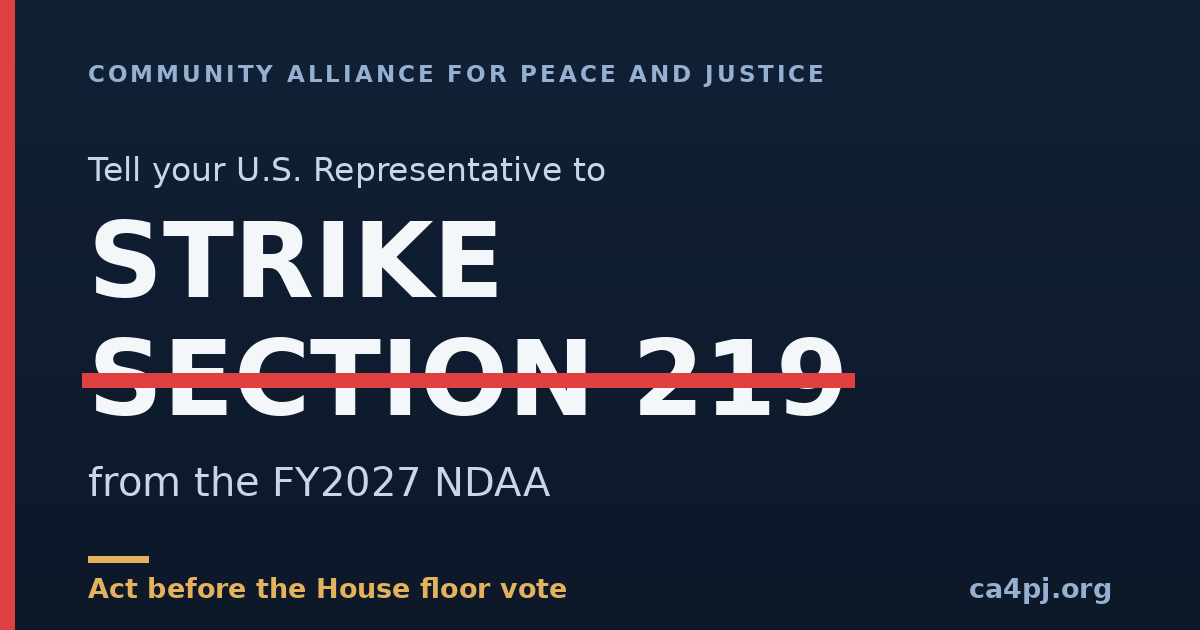
 A New Policy Staff


 Sharon Zhang

 Haley Fuller
 Haley Fuller
 Taija PerryCook
 Sarah Davis and Filip Timotija
 Austin Campbell
https://www.commondreams.org/opinion/us-israel-military-merger
Other views:
 Matthew Kenney